

Japan Detour
Don't Fly to Ogasawara. You Can't.
The Ogasawara Islands sit 1,000 kilometres south of Tokyo, and the only way in is a 24-hour ferry. That crossing is not the price of the trip. It is the trip.
Nov 24, 2026 · 7 min read
The Ogasawara Islands sit 1,000 kilometres south of Tokyo, and the only way in is a 24-hour ferry. That crossing is not the price of the trip. It is the trip.
In Tokyo, the farthest normal commute runs about two hours. The prefecture also holds islands a full day away by sea. Same government, two different clocks, and the gap between them is the whole story.
The Ogasawara Islands are a chain of more than 30 volcanic islands about 1,000 kilometres south of central Tokyo, in the western Pacific. They belong to Tokyo administratively, they were inscribed on UNESCO's World Heritage List in 2011, and they carry the nickname "Galapagos of the Orient" because their plants and animals evolved in isolation, on islands that were never joined to a continent. Total land area is about 105 square kilometres. Only two islands are inhabited: Chichijima, where the ferry docks, and Hahajima, 50 kilometres further south.
The obvious reading is that the islands are wild because they are remote, and the 24-hour ferry is the price of admission. That reading gets the causation backwards. The ferry is not the price of the wildness. The ferry is the mechanism that keeps it.
Call it the 24-hour filter. One ship, the Ogasawara Maru, makes the crossing, and in the November to February timetable it sails from Tokyo every six to eight days. There is no airport, and an airstrip on Chichijima has been discussed for years without a decision. Tickets go on sale two months before departure. Fares reset every month with a fuel surcharge, and the cheapest berth, a shared second-class tatami room, cost ¥30,030 one way in November 2026. A place inside Tokyo, the most connected city on earth, still runs on a ship's timetable. The puzzle is not why the islands are hard to reach. The puzzle is what the difficulty does.
It decides the length of your trip before you decide anything else. The ship leaves Takeshiba Pier at 11:00 and reaches Futami Port on Chichijima at 11:00 the next day, about 24 hours at sea, and the operator's own FAQ puts the voyage at about 25 and a half hours over roughly 1,000 kilometres, longer in rough seas. Then the ship waits in port for about three days before sailing back, so the usual trip is six days: two nights on board, three on the island. In peak season the cycle shortens to about three days, but the logic never changes. You do not add Ogasawara to a Tokyo trip. You pick a sailing, and the sailing picks your dates.
If this is the kind of trip-shaping detail you want in your inbox twice a week, the button below is the way in.
The Sailing Is the First Night

The ship leaves Takeshiba Pier at 11:00. The crossing is the first night of the trip, not the transit before it. Photo: Ootahara, CC0, via Wikimedia Commons.
The crossing reframes what a travel day is. The cheapest way across is a shared second-class tatami room, a carpeted hall where strangers sleep side by side, and private cabins run several times that fare. Either way, you spend a full day watching the Izu Islands pass and the sea empty out, and you arrive at 11:00 the next morning with the island already setting the pace. Most trips treat transport as dead time to minimize. Here the transport is the first thing the trip is about, because it is the filter doing its work in plain sight: everyone on board chose to give up a day.
The Wave-Off

Departure is a village event. The ship is waved off from the quay and followed out by boats in the harbour, because the next one is days away. Photo: Ootahara, CC0, via Wikimedia Commons.
The filter is social, not just logistical. When the ship leaves Chichijima, the pier turns into a farewell party, and boats follow it out of the harbour while people on shore wave. That ritual only makes sense because the next ship is days away. A departure every hour is a timetable; a departure every week is an event. The island marks it the way a small town marks the last train, except here the last ship is the only ship, and missing it means waiting out the cycle.
The Second Rationing
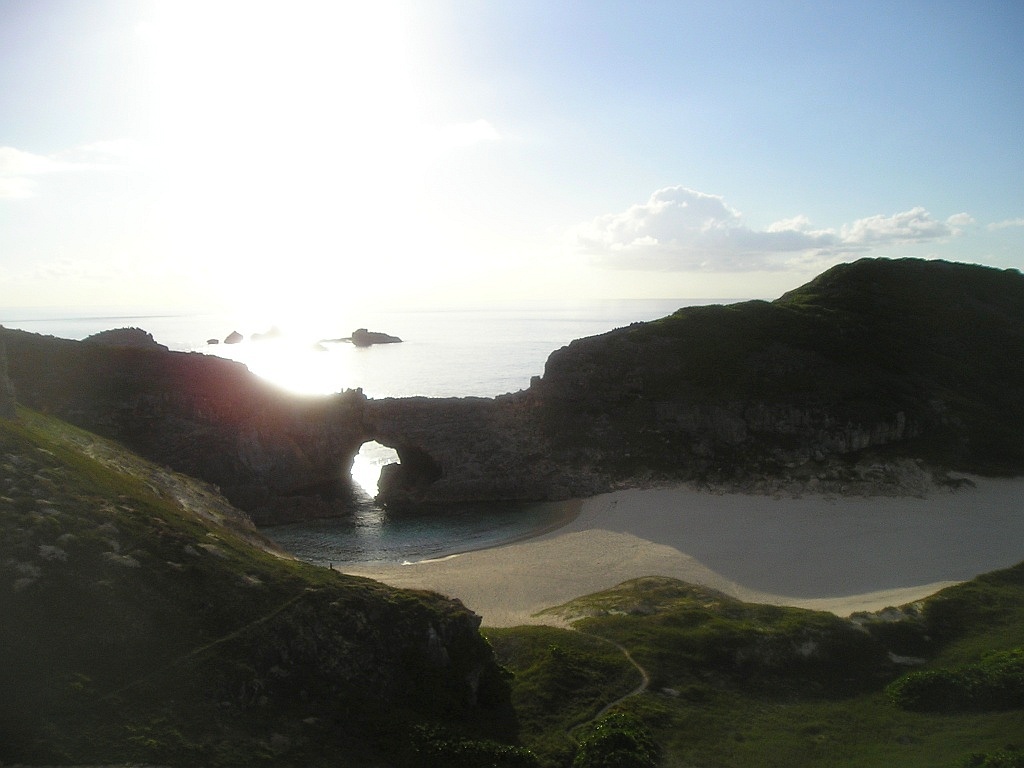
Minamijima, a drowned limestone islet off Chichijima. Landing is guide-only, capped, and closed for part of the year. Photo: Si-take, CC BY-SA 3.0, via Wikimedia Commons.
Even after the 24-hour filter, the most fragile place gets a second one. Minamijima, a limestone islet about 20 minutes by boat from Futami Port, can be landed on only with a guide certified by the Tokyo Metropolitan Government, no more than 15 people per guide and 100 a day, two hours per group, and no visits at all from mid-November to January. Visitors rinse their shoes on landing to remove soil and seeds. Brown boobies nest on its southwest side, and green turtles come ashore in summer to lay their eggs. The rules read like a rationing scheme because they are one: the island that survived by being unreachable is now protected by counting the people who reach it.
The Second Island

Futami Port is the hinge of the whole trip. Every plan, every return, and every second island passes through this pier. Photo: Si-take, CC BY-SA 3.0, via Wikimedia Commons.
The filter has layers. Hahajima, the second inhabited island, sits about 50 kilometres south of Chichijima and is reached only by the Hahajima Maru, a smaller ferry that takes about two hours and runs on a timetable coordinated with the big ship. The further you go, the fewer people come with you, and the more the journey itself becomes the itinerary. Ogasawara is not one remote place. It is a sequence of filters, each one thinning the crowd that the last one let through.
A few honest caveats. Rough seas slow the ship, and a typhoon can change the schedule, so there is no other scheduled way home and buffer days plus travel insurance are not optional extras. Peak season adds sailings, which shortens the cycle, but it also adds demand, and tickets open only two months out. The cheapest berth is a shared room, not a cabin, and the whole trip costs a week of calendar for three days on the island. None of that is a flaw in the plan. It is the plan, and it is the reason the islands are still the islands.
If You Go
Book the ship first, in both directions, as soon as tickets open two months before departure, and only then book a bed on Chichijima for the days the ship is in port. Check the operator's timetable and fare pages before planning anything else, since sailings run every six to eight days in the winter timetable and fares reset monthly with a fuel surcharge. Humpback whales come to breed from December to May, with February to April the best months to watch them, sperm whales are seen from May to November, and dolphins are seen all year. Hahajima needs the connecting Hahajima Maru, timed to the big ship, and the return sailing leaves Chichijima in the afternoon, so plan the last island day around it.
Tokyo's trains run to the minute. Its farthest islands run to the sailing. The question is not whether you can spare six days. It is whether you still want a place that asks for them.
Footnotes
- Ogasawara Kaiun, English service page: timetable, fares, and booking. https://www.ogasawarakaiun.co.jp/english/service/
- Sailing cycle, six-day round trip, and November 2026 fares: https://discover-japan.info/japan_regions_kanto_tokyo/ and https://konomachi-note.jp/en/tokyo/guides/play-ferry-from-tokyo/
- UNESCO inscription, island geography, and the weekly ferry: https://www.heritage.world/sites/ogasawara-islands/
- "Galapagos of the Orient," land area, and no airfield: Government of Japan, Highlighting Japan, November 2021. https://www.gov-online.go.jp/pdf/hlj/20211101/hlj202111_12-13_The_Ogasawara_Islands.pdf
- No airports, 24-hour ferry, Hahajima Maru: https://en.wikivoyage.org/wiki/Ogasawara_Islands
- Minamijima landing rules and whale seasons: https://sockmonkey.com/places/ogasawara-islands
- Hahajima Maru timetable: https://www.ogasawarakaiun.co.jp/english/service/hahajima.html


